

Windsor, Ontario, is a Canadian city that sits quietly on the Detroit River, directly across from Detroit, Michigan, in the United States. Most days, life here seems ordinary. But around 2011, residents on Windsor’s west and south sides began noticing a low, rumbling noise. Over time, this mysterious sound came to be known as the Windsor Hum, or simply the hum.
People described it in many ways, often emphasizing how it felt more than it sounded:
- Like a diesel truck idling nearby.
- A low, constant rumble that shook homes and rattled dishes.
- Vibrations so strong they caused headaches and disrupted sleep.
- “If you think of thunder, and you take that thunder and constantly repeat it for hours and days, weeks, that’s all it is,” one resident told The Guardian.
- A pulsating vibration at a low frequency, described as around 35 Hz.
- A loud, ominous sound reminiscent of a booming speaker.
No matter how people described it, a few things were clear: it was relentless, intrusive, and maddening. Some residents relied on sleeping pills to cope; some medicated stressed pets who reacted to the hum they themselves could barely hear. By 2012, more than 20,000 people joined a public teleconference to share concerns, from stress and anxiety to potential effects on pregnancy and home foundations. By 2016, reports suggested the hum was getting louder and more pervasive.
The hum didn’t follow a pattern. It appeared unpredictably, sometimes lasting just hours, other times stretching for days, often growing stronger at night. Determined to understand it, curious residents placed microphones throughout Windsor, collecting hours of recordings, hoping to identify its source.
Investigating the Windsor Hum
As complaints grew, the Canadian government stepped in. In 2013, Natural Resources Canada conducted an initial study, confirming that the hum was real but unable to identify its exact cause. Data suggested the sound appeared to originate from across the river.
With federal resources limited, the University of Windsor received funding to continue research. The project had two phases: first, to confirm the hum’s existence and describe its characteristics; second, to use advanced techniques to narrow down potential sources, all without direct access to the suspected site.
Remote acoustic monitors across Windsor confirmed a low, pulsing vibration around 35 Hz, the kind of deep tone you feel in your chest near a subwoofer. Much of the evidence pointed toward one place, though the researchers could not step foot on American soil to confirm it. Professor Colin Novak, one of the lead researchers, later described the project as “like chasing a ghost.”
Zug Island
Finally, the mystery could be named: Zug Island.
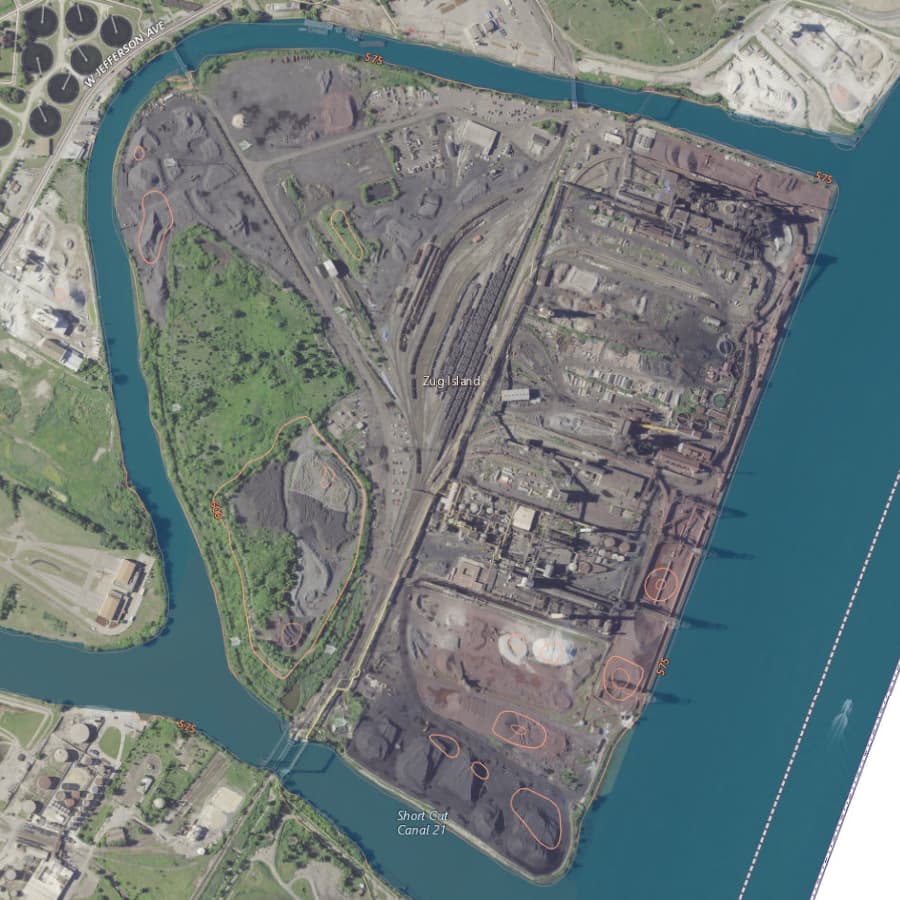
Photo by USGS, Public Domain, via Wikimedia Commons
To understand the Windsor Hum, picture Zug Island. It looks like a scene from a dystopian novel, sitting just across the river from Windsor, on the American side, shrouded in smoke, machinery, and fences. You can even spot it on Google Maps: a dark, blocky landmass with the canal looping around it and two heavily guarded bridges connecting it to the mainland.
But Zug wasn’t always an island. In the late 1800s, Samuel Zug purchased a marshy peninsula along the River Rouge, once believed to be an indigenous burial ground. In 1888, he authorized the Short Cut Canal through his property, effectively turning it into a man‑made island. Over time, it became one of North America’s most industrialized patches of land, eventually hosting U.S. Steel’s operations.
By the early 20th century, Zug Island had become integral to Detroit’s steel and automotive complex. The place roared like an industrial volcano whose heartbeat never stopped. Only two bridges connect the island to the mainland, and both are heavily guarded.
Access to the island is severely limited. Bridges and rail links exist, but the land is fenced, guarded, and largely off‑limits to the public. That inaccessibility deepened the mystery around the hum; the very place that appeared to be the source was locked away from outside investigation.
For Windsor residents, Zug Island loomed across the river, visible but unreachable. Its smokestacks, machinery, and fortified perimeter gave it an almost dystopian appearance, a stark, uninviting industrial landscape seemingly tied to the mysterious hum shaking their homes.
The Hum Comes to a Halt
While the investigation unfolded, residents simply had to endure the noise. Fans, white noise machines, sleeping pills, and even medications for pets became common. The hum affected sleep, work, and daily life, creating a shared experience of frustration.
By 2020, the hum mysteriously faded, coinciding with U.S. Steel idling its blast furnaces. Timing suggested a connection, though many questions remain: why had the hum only started in 2011, over a century after the island became industrialized? And why was it felt strongly in Windsor, but barely in Detroit?
The Hum: A Global Phenomenon
Windsor isn’t alone. Similar low-frequency “hums” have been reported in Taos (New Mexico), Bristol (UK), Auckland (New Zealand), and Frankfurt (Germany). Scientists and enthusiasts have even created a World Hum Map, tracking thousands of locations where low-frequency hums are perceived.
If you do hear the Hum and it’s bothering you, practical steps you can take are outlined in this guide.
For a more in-depth exploration of the Hum itself, see this detailed article.